


Underrated Martial Arts Movies To Watch If You Loved (Or Hated) 2026's "Street Fighter"


Video game adaptations are continuing their resurgence in the mainstream (only this time they aren’t notoriously awful), and Street Fighter recently blasted its way onto big screens. With all of its vibrancy, cheesy one-liners and hard-hitting action, it’s almost impossible not to have a good time- almost.
Whilst it certainly isn’t perfect, it may have you interested in exploring more martial arts-centric movies, and boy, oh boy, have you come to the right place. Whilst I’m not writing about film or talking into my camera recommending you cinematic hidden gems, I’m in the gym getting punched in the face by teenagers or other disgruntled adults.
If we're gonna talk martial arts movies though, don’t expect the usual Enter the Dragon, Crouching Tiger or The Raid. Fantastic movies indeed, but that’s not how we do things at Outside the Spotlight.
So, here are six underrated and under-appreciated martial arts movies that might scratch the itch you didn’t even know you had.
Polite Society (2023)

If you're after more of the over-the-top absurdity of Street Fighter, Polite Society has you covered times a hundred.
A genre mash-up written and directed by Nida Manzoor in her feature film debut, it follows teenager Ria Khan (Priya Kansara) who is struggling with her sister's arranged marriage and the questionable motives of her husband-to-be and his mother (played like a Disney Witch in a wonderfully quirky performance by Nimra Bucha).
Ria is a martial artist-in-training and aspiring stuntwoman, and so possesses the tools (although still developing) to pull off the most ambitious wedding heist of all time.
Polite Society is part martial arts movie, part coming-of-age story, part satire on South Asian British culture, and part tale of sisterly love. It's fun, funny, and utterly absurd. But it's also endearing, sincere and packs enough emotional and physical punches to keep you locked in- even if it's just to find out what they could possibly try to throw in next.
The Assassin (2015)

On the opposite side of the spectrum, Hou Hsiao-Hsien's The Assassin is loosely based on the ninth-century Chinese short story Nie Yinniang, and stars the legendary Shu Qi (The Transporter, So Close) as the eponymous assassin of the same name.
After failing a mission, she is sent back by her master to her hometown to kill the man she loves- in order to test her resolve.
Whilst the original story is a core text in Chinese swordsmanship and wuxia fiction, don't come into this expecting the high-energy, almost-superhuman action you'd see in films like Zhang Yimou's Hero (2002) or House of Flying Daggers.
The Assassin is restrained, deliberate and keeps things grounded. It doesn't overload your senses and it doesn't feel the need to fill in all the gaps for you either. Director Hsien stated “I don’t think that plot is the only way to appeal to an audience. The audience can catch the message of a film through landscape, character, details.”
He also said that the best films are those that allow your imagination to continue long after you've finished watching, and indeed, The Assassin is a film that continually returns to my mind. It fundamentally changed how I perceive cinema, demonstrating the power of pure visual language, and showing how films aren't just stories but experiences, and that meaning can be found outside of typical narrative realms.
Duel to the Death (1983)

If you are after those more fantastical wuxia elements and a martial arts film built around a high-stakes duel, rather than one that pushes its fighting into the background in favour of character development, start here.
Duel to the Death is the directorial debut of Ching Siu-tung, who served as action choreographer for Hero and House of Flying Daggers as well as Shaolin Soccer. It follows two swordsmen in 16th-century China, who uncover a plot surrounding a duelling tournament held every 10 years between China and Japan to defend their country's honour.
It’s a spectacular showcase of classic wuxia action, with gravity-defying sword fights and an almost surreal approach to combat. With its wild, boundary-pushing practical effects and wirework, there are giant ninjas, and ninjas riding on kites.
It's a great one if you’re looking for something that captures the larger-than-life spirit of Street Fighter while taking you back to the golden age of Hong Kong action cinema. If you think you’ve seen it all, Duel to the Death is about to prove you wrong.
The Grandmaster (2013)
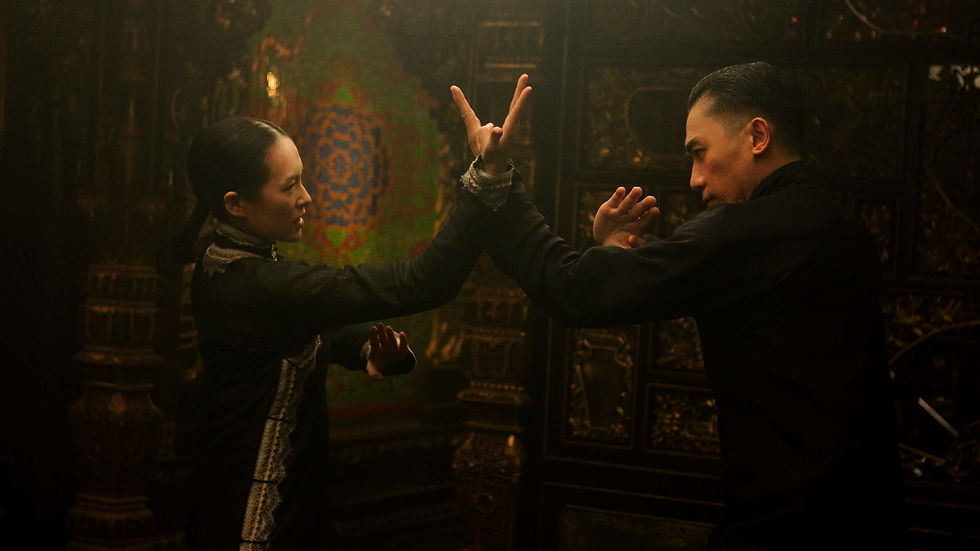
Sitting somewhere between The Assassin and Duel to the Death is The Grandmaster- Wong Kar-wai's adaptation of Ip Man's story- the famed wing chun grandmaster and teacher of Bruce Lee. Ip is one of the most prominent figures in martial arts cinema, thanks to Wilson Yip's Ip Man series starring Donnie Yen.
Wong's works are characterised by nonlinear narratives and distinct atmosphere, as seen in his romantic dramas such as Chungking Express, In the Mood for Love and 2046. He is certainly not a filmmaker whom you'd typically associate with martial arts cinema. Although The Grandmaster isn't his first venture into the genre, as he directed Ashes of Time in 1994, it is by far his most accomplished.
Contrary to the type of action you'd get in the fast-paced Ip Man fight sequences choreographed by the legendary Sammo Hung (Project A, Wheels on Meals, Dragons Forever), the action in The Grandmaster, choreographed by Yuen Woo-ping (director of Drunken Master, Iron Monkey, Wing Chun, Blades of the Guardians) is slower-paced, more stylish and more focused on the underlying philosophies of kung fu.
Starring frequent Wong Kar-wai collaborator Tony Leung, as well as Ziyi Zhang (Crouching Tiger, Hidden Dragon, Hero, House of Flying Daggers, Rush Hour 2, Memoirs of a Geisha), The Grandmaster follows Ip Man's rise through the martial arts world during the political upheaval of 1930s and 40s China, where rival masters challenge one another to prove their worth and preserve their traditions.
It is a film that treats martial arts as both a physical discipline and an art form. With fights unfolding through rain-soaked streets, snow-covered courtyards and beautifully composed interiors, The Grandmaster is a visually mesmerising affair even before the first punch is thrown. The combat itself is punctuated by slow motion with intricate focus. Wong uses combat to reveal character, pride, restraint and the philosophies that underpin these ancient traditions.
Broken Oath (1977)

During the 1970s, martial arts movies were on an undeniable rise in the mainstream. Bruce Lee was making waves in Hollywood with Enter the Dragon and Jackie Chan was solidifying himself in Drunken Master. But a little further across the horizon, with her swords crossed, was one Angela Mao.
Mao might not be a name that many are familiar with today, as she quietly retired from acting in 1992. With hits such as Hapkido and Lady Whirlwind as well as a small role in Enter the Dragon, she is widely considered one of the greatest martial arts stars in cinema history.
Broken Oath is an unofficial, loose remake of the 1973 Japanese film Lady Snowblood, one of the movies that Quentin Tarantino ripped off with Kill Bill (don’t get me wrong, I love Kill Bill). Lady Snowblood is itself an adaptation of the manga series of the same name.
Directed by South Korean director Chung Chang-wha (King Boxer), Broken Oath follows Mao as “Pure Lotus” Liu Chieh Lien, a formidable kung fu fighter who, after discovering the truth about her parents' violent past, sets out to hunt down the men responsible.
Armed not only with her martial arts skills but her collection of pet scorpions, Broken Oath employs fast-paced, hard-hitting action as Mao proves exactly why she deserves her reputation as one of martial arts cinema’s greats. The film also has this old-school charm with its dated (not in a bad way) special effects adding to the film’s distinctly 1970s feel. There’s even an appearance from Sammo Hung.
It might not be as well-known as some of Mao’s other work, but Broken Oath is a must-watch for anyone looking to dig a little deeper into the world of martial arts cinema.
Chocolate (2008)
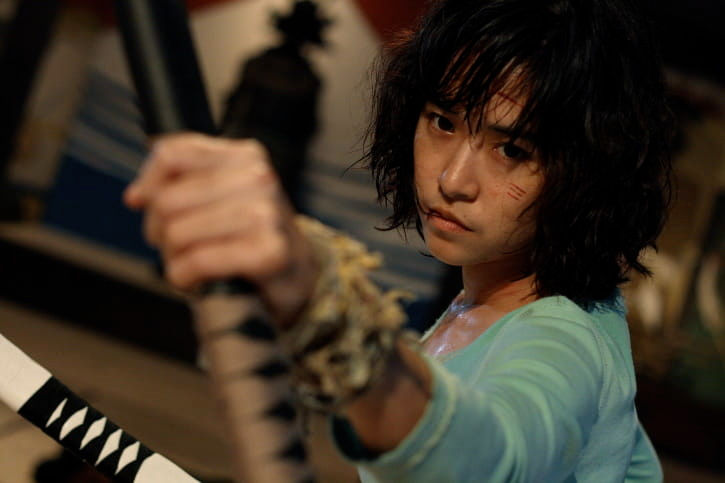
When it comes to the Thai martial arts filmscape, a lot of people don’t go past Ong-Bak starring Tony Jaa. They might go a little further to Tom-Yum-Goong, also starring Tony Jaa. Other than Jaa, these two films have director Prachya Pinkaew in common, and another of his films that doesn’t get enough love is 2008’s Chocolate.
Starring Yanin Vismitananda (The Furious, Tom Yum Goong 2) as Zen, Chocolate is every bit as brutal as Pinkaew’s previous efforts. What makes this particularly interesting, however, is the inclusion of an autistic protagonist. Rather than simply being a gimmick, Zen’s autism shapes how her relationship with martial arts develops, and is central to both her character and the film’s approach to action.
Zen is infatuated with martial arts from a young age and is able to accurately mimic what she sees in the movies she loves, starring the likes of Tony Jaa and Bruce Lee. Those skills become useful when her mother is diagnosed with cancer, and Zen decides to collect her medical care funds from debt-owing gangsters with whom her mother was previously affiliated.
What follows is a relentless showcase of Yanin’s physical ability that makes Chocolate stand out even among Thailand’s best-known martial arts films. There’s a real charm to watching Zen’s movements evolve from mimicking the martial arts films she adores into a fighting style of her own, and the choreography is all the more impressive for how much of it Yanin performed herself. If you’re looking for a martial arts film that delivers the bone-crunching action of Ong-Bak while offering something a little different, Chocolate is well worth your time.
Honourable mention: So Close (2002)

Martial arts movies don't always have to be gritty, bone-crunching affairs with historical setting and swords. Sometimes they can be graceful, futuristic and impossibly slick. But still with swords.
The early 2000s had a particular aesthetic- slow motion, sunglasses, long jackets and undeniable gloss; and Hong Kong adapted to this extremely well.
Beginning in the 1980s with Corey Yuen's (Righting Wrongs/Above the Law) Yes, Madam starring Michelle Yeoh (Crouching Tiger, Hidden Dragon, Everything Everywhere All at Once, Wicked) and Cynthia Rothrock (Righting Wrongs/Above the Law) Hong Kong action cinema established a distinct subgenre dubbed "girls with guns." It would lose its momentum by the mid-90s, but saw a revival in the early 2000s which would expand to Hollywood with efforts like Tomb Raider (2001) and Kill Bill (2003). In Hong Kong, Corey Yuen would continue with films like So Close.
Starring Shu Qi, Zhao Wei and Karen Mok as two assassin sisters and the detective who finds herself on their trail, what makes this one such a fun watch is its unapologetic commitment to style. Its balletic action, pristine white aesthetic, and Bond-style gadgets make it so distinctive of it's time. It's less concerned with the the raw physicality of something like Chocolate than with the sheer spectacle of watching impossibly cool characters pull off impossibly cool things, all the while their hair blows in the wind like a L'Oreal commercial. Not to mention a soundtrack that practically screams 2002.
There's something wonderfully nostalgic about it all.

If you love a good martial arts movie and are tired of the typical recommendations that you've probably already seen, I hope that you find something here that reignites the spark like the epic clashing of two swords.
You Might Be Interested In:
Read About Great Indie Movies:
Interviews:


Comments